Thursday, May 21, 2020

ACHARYA NAGARJUNA AND ZEN TEACHINGS


The Zen Teachings of Nagarjuna

by Vladimir K., June 2004

Nagarjuna, characterised as a Buddhist philosopher by many Western philosophers and scholars, is perhaps best approached not as a Buddhist philosopher (although he certainly was that) but as a Mahayana teacher. In the Zen tradition, he is the 14th Patriarch. He is also recognized as a patriarch in Tantric Buddhism and the Amitabha Buddhist sects. As Dumoulin  points out, it was not his logical dialectics that made him a revered figure, but his “religious vitality that has had the greater influence”.

Nagarjuna is considered the founder of the Madhyamika (the Middle Path/Way) school, a branch of the Mahayana Buddhist school. 

A list of all the works attributed to this near-mythic figure would include a wide variety of texts still extant in Tibetan, Chinese and Sanskrit (Mabbett), but, as Mabbett notes, many of the texts “are not taken seriously” as coming from the hand of Nagarjuna. 

Likewise, Nagarjuna’s life is obscured by hagiography and mythology (see Tharchin, (n.d.) for a typical example) and even the dates of his life are uncertain, although somewhere between the first and third centuries would be acceptable to most scholars. None of this needs concern us here. What is generally accepted is that the core text of the   Madhyamika school, the Mulamadhyamakakarika (Fundamental Stanzas on the Middle Way) is assigned to Nagarjuna and is one of the most important and influential texts in Mahayana Buddhism. 

However, Nagarjuna often perplexes, even frustrates upon a first reading. As David Loy  comments, Nagarjuna’s writing is a “laconic knife-edged logic that wields distinctions that no one had noticed before and that many since have been unable to see the point of... splitting what some see as conceptual hairs.”

One of the difficulties a Western reader has with Nagarjuna is that the Mulamadhyamakakarika is based on classical Indian, rather than Western logic. Western logical traditions see only two possibilities in an argument — truth or falsity. It may try to prove another truth through negation. For example, if a car is not red, it must be some other colour. Indian traditions use four positions: true (not false), false (not true), both true and false, and neither true nor false (prasanga or tetralemma). Needless to say, this form of argumentation is difficult for a Western reader used to a completely different line of reasoning. However, Nagarjuna goes even one step further, basically arguing, “None of the above”, leaving the reader with nowhere to go and nothing to grasp. Nagarjuna used negation not to prove another viewpoint or truth but to negate all viewpoints. He thereby destroyed all logical arguments or speculation about Ultimate reality, denying the inherent existence of any such ‘reality’.

In this essay I will outline some of Nagarjuna’s basic teaching based on his Mulamadhyamakakarika and show the relationship between Nagarjuna’s writings and subsequent Zen teachings. While Nagarjuna is undoubtedly one of Buddhism’s greatest philosophers, his writings are best approached as teachings for Buddhists. 

The Mulamadhyamakakarika  should  not  be  seen  as  a  new philosophy but as a clarification of the Tathagata’s teachings which ends all speculation of metaphysics. While Zen Buddhism denies the efficacy of philosophising as a pathway to liberation, it took up many of the principles  outlined  in  the  Mulamadhyamakakarika  and  applied them in a practical way to end ignorance and relieve suffering. Nagarjuna and the old Zen masters had the same goal in mind. Only the approaches differed. Both  are  nothing  more  than  upaya (skillful means of teaching).

An Outline of Nagarjuna’s Teachings

The Mulamadhyamakakarika is a dialectic, often difficult to follow, and I believe it would be a mistake to pull out one tenet and say that this or that is the main idea or central philosophy of the work. Philosophy is concerned with attempting to explain or describe the essence or the existence of reality. Human beings have a need to philosophise about their existence as otherwise they would feel groundless and undirected, so philosophy does have its place in our lives, based on a conventional reality; but there is no philosophy that can explain ultimate truth. 

Nagarjuna (and the Tathagata) held that all philosophy and speculation on reality leads not to knowledge but to illusion. The goal is not a new philosophical view of life, but the abandonment of all views. It is only then that true wisdom arises. The Tathagata refused to speculate on metaphysics, saying that such speculation was a waste of energy, irrelevant to knowing the Ultimate Truth as the Ultimate Truth was not this, not that, not both nor not either (the tetralemma). Inquiring into Ultimate causes and purposes through philosophy, the Buddha taught, was fruitless. A man struck by an arrow does not need to know what wood was used for the shaft nor where the arrowhead was forged, but he does need to know how to remove the arrow. Some say the Buddha worked more as a spiritual doctor than simply as a teacher. He diagnosed the disease (suffering), identified its cause (ignorance and craving), determined whether it was curable (there is a cure) and outlined a course of treatment (the Eightfold Path). 

Following the Buddha’s path of eliminating all philosophical speculation, Nagarjuna used the process of reductio ad absurdum, a negation of all viewpoints on any topic to reveal that all arguments which attempt to prove or disprove the existence of any conceivable statements about Ultimate reality are untenable, unintelligible and contradictory, thereby dispelling all philosophical viewpoints, all extremes of thought and setting one clearly on the path of the Middle Way taught by the Buddha and towards wisdom and the end of suffering.

Nagarjuna’s dialectic can be brought down to four basic propositions:

All things (dharma) exist: affirmation of being, negation of non-being

All things (dharma) do not exist: affirmation of non-being, negation of being

All things (dharma) both exist and do not exist: both affirmation and negation

All things (dharma) neither exist nor do not exist: neither affirmation nor negation  

(Dumoulin,1998:43)

From this tetralemmatic dialectic, Nagarjuna argued neither  production nor destruction; neither annihilation nor permanence; neither unity nor difference; neither coming nor going. He thereby refuted all metaphysical speculation about  Ultimate Reality or “the highest truth” (paramartha-satya).

It is possible to say that there are three important, but, in true Buddhist fashion, interconnected, ideas in the work, none of which can stand on its own but which together make up the central thrust of the teaching. They are the two truths doctrine, emptiness (sunyata) and dependent arising or co-dependent origination (pratityasamutpada). Together, these three make up the Middle Way of Nagarjuna. In just twenty-seven chapters of four hundred verses, Nagarjuna tackles some of the most difficult and esoteric teachings of the Buddha, systematizing the heart of Zen practice, the Prajnaparamita Sutra. While for convenience I will discuss each of the three separately it must be kept in mind that none stand on their own and, even more importantly, none should be taken as some kind of “ultimate truth”; they are but pedagogical devices allowing us a way of knowing the empty nature of truth. Nagarjuna rejects all philosophical views, including his own, and claims that he asserts nothing. All concepts, including sunyata and Pratityasamutpada are but provisional names and have no independent meaning of their own. Furthermore, nothing Nagarjuna wrote was based on his own creation; all his works were espousing the teachings of the Buddha, not his own original thoughts. Nagarjuna was trying to explain the Buddha’s teachings, not present some new teaching of his own.

The two truths doctrine is based on the view that there are two realities: conventional reality and the truth about this reality (a “lower truth”), and ultimate reality and its truth (a “higher truth”).

In the final analysis, however, Nagarjuna rejects this duality and teaches that both realities are one and the same. 

It is our so-called ‘common sense’ understanding of the world that causes the problem because we tend to see the world as a collection of discrete entities interacting with each other and with the self. In the Buddhist view, this is called ignorance and leads to suffering (dukha). 

The two truths doctrine is based on the practicality of teaching (upaya) rather than dogma. From a conventional viewpoint, we can say that things are causally produced and are impermanent but from a higher viewpoint, causal production and impermanence (or permanence) cannot be established and dualistic thinking must be rejected.

Conventional reality is our normal day-to-day reality that we all experience. When you stand in the rain, you get wet; when you haven’t eaten for a while, you get hungry and if you fall off a cliff, you get hurt. This is a common-sense reality. The truth of this reality is not so simple. There is the truth that our senses tell us. A broken leg hurts. A doctor treating the leg is aware that her patient is suffering pain and although she herself does not feel the pain, she acknowledges that there is pain. Which leads us to a second type of truth, the truth of common agreement. This truth is a relative truth, often based on socio-cultural factors. 

Another truth could be linguistic truth. In English we have no difficulty distinguishing a table from a desk. In other languages, this may not be so. To some a table is nothing more than four sticks surmounted by a slab of wood. The table exists only because we call it a table and it is dependent on wood, on its parts, on its uses and upon agreement by us that it is indeed called ‘table’ and not ‘desk’. (Garfield, 1994) The table has no existence outside of the materials it is made of and the person who constructed it and the agreement among those who use it that we are talking about a table. Post-modernists would have no difficulty with these types of conventional truths, truth being in the eye of the beholder and there being no ‘ultimate truth’.

The mistaken belief that ‘conventional’ reality is the ultimate reality is called ignorance, which leads to samsara, the world of pain and suffering and ignorance. We tend to believe that once a thing exists (such as a table), it is not only distinct from all other things, but can continue existing unchanged until such a time as something affects it to cause a change. Our tendency to objectify the world around us, while it may be convenient, causes us to believe that things (and this includes ourselves) have an independent ‘self-existence’. Nagarjuna’s dialectic was all about destroying this viewpoint.

Huntington  defines  conventional  truth  in  a  way  that  opens  the door to Nagarjuna’s other teachings: “The sole criteria for empirical reality is existence within the nexus of cause and effect which defines our shared sociolinguistic experience.” Conventional truth allows things to arise, to exist and to fade away. Conventional truth allows causes to arise and to create effects. But this understanding of cause and effect is a ‘lower truth’. 

An understanding of cause and effect  is essential in the Mulamadhyamakakarika. More on that later.

Ultimate truth for Nagarjuna is the truth of an enlightened clarity which does not mistake the conventional for something essential (reification). This is where emptiness comes in as Nagarjuna teaches that all things are empty and the understanding of this emptiness leads to a greater truth of the way things really are. Of course, fundamentally, there is no real difference between the two realities as this “truth of the highest meaning” posits that “individual existence cannot be grounded outside the context of everyday experience,” (Huntington) thereby linking the two realities into one. 

In other words, a ‘higher’ truth is based only on conventional reality, not on a metaphysics. Emptiness is another central doctrine of the   Mulamadhyamakakarika. Without emptiness (sunyata) there could be no two truths. Without emptiness, there could be no dependent arising (pratityasamutpada). What is important to realise about emptiness is that it does not deny the existence of things (conventional reality) but says that all things (everything) have no intrinsic essence. In other words, nothing exists on its own, divorced or separated from other things. Therefore, everything is interconnected and cannot exist without these ‘other things’, including the self. It’s also important to realise that Nagarjuna really does mean everything, without exception, including the Self, including thoughts, volition, beliefs—quite literally everything. For example, Nagarjuna argues that spatial properties cannot exist on their own. A location cannot exist without an object to be located in that space and, conversely, there cannot be an object without a location for it as all objects must have a location for them to exist in. Both object and location are dependent on each other.

Nagarjuna goes on to show that everything is dependent on something else to exist. Nothing can exist without something else existing. This is the meaning of emptiness. And this is dependent arising (pratityasamutpada).

Nagarjuna explains:

Whatever is dependently co-arisen

That is explained to be emptiness

That, being a dependent designation

Is itself the middle way.

Something that is not dependently arisen,

Such a thing does not exist

Therefore a non-empty thing

Does not exit.

Here Nagarjuna links pratityasamutpada to sunyata and the two together is the Middle Way of Buddhism. The two are intimately  linked: if something is dependent on something else to manifest, it is empty and has no self-existence. And if something is empty, it depends on something else to come into being; it cannot manifest on its own. Furthermore, everything that is mutually dependent must have a uniqueness or particularity of its own, at least in terms of ‘form’. We can say things are alike, but we cannot say they are identical or the same. For example, the cup that holds my coffee as I write this has a twin in the cupboard. They both look exactly the same, were made at the same factory, possibly by the same people, but they are not one and the same cup. If I break this one, the other will still exist, unbroken. Notice that none of this denies the existence (conventional reality) of things, only that conventional reality does not have an inherent essence or being. This is sunyata; this is pratityasamutpada. If everything is empty and everything is pratityasamutpada, (dependent arising) then everything seems to have a cause so it can arise. The philosophical argument between cause and effect and their relationship is one that has always puzzled philosophers, Eastern and Western, one which Hume saw as “an esoteric and metaphysical” problem. (cited in Huntington) Buddhism recognises two types of causality: sequential and simultaneous. 

The first, sequential, is our conventional reality. We first have a cause and then an effect. First I make the coffee, then I drink it. It is uni-directional and non-reciprocal. In other words, I can’t drink the coffee before I make it. However, Buddhism sees not only a conventional cause and effect based on two aspects (the cause and its effect) but on cause, condition and effect. 

Based on the fact that there must be a condition (pratyaya) as well as a cause before an effect comes into being means that “things or events are understood to originate and cease conditionally” and do not necessarily manifest sequentially and may be reciprocal, i.e., reversible.

Abe and Jay Garfield defines condition as “an event or phenomenon whose occurrence or existence is correlated with that of another.” Nagarjuna said: “These give rise to those, So these are called conditions”. (quoted in Garfield, 2001) This is expressed in the famous four-line stanza:

When this is present, that comes to be

From the arising of this, that arises

When this is absent, that does not come to be

On the cessation of this, that ceases

Here we can see non-duality at work. If we substitute the pronouns “this” and “that” for something concrete, we can get a sense of pratityasamutpada.

When (conventional) reality is present, nirvana comes to be

From the arising of (conventional) reality, nirvana arises

We can also say, therefore, quite logically and without contradiction:

When nirvana does not come to be, (conventional) reality is absent

When nirvana ceases, (conventional) reality ceases.

Through this argument, one can say that origination is reversible and things arise simultaneously, co-dependently. We can substitute any apparent duality into the stanza: when bigness is present, smallness comes to be and when smallness comes to be, bigness arises; when good is present, evil comes to be and when evil comes to be, goodness arises; when life is present, death comes to be and so on. The argument here is circular rather than linear. Hence, duality is undercut as everything is co-dependent arising. Consequently, nothing has its own self-abiding nature or can exist on its own. It is not that Nagarjuna is denying cause and effect; what he is warning against is “confusing a functional property of the causal conditions with an existing, essential property.” It is only in this sense that we can say that things do not ‘exist’ or are unreal. This is the “nature that is no nature”.

The Hinayana Buddhists used this argument to explain moral as well as physical phenomena, and Nagarjuna saw that the early Buddhists took pratityasamutpada as an objective law governing all things. To refute any law or truth as universal, he argued that trying to explain a relationship between cause and effect is impossible and just ends up in meaninglessness or absurdity. The danger Nagarjuna saw was our tendency to search for metaphysical answers to the nature of reality and our life, to create an understanding of life and then to cling to this answer as the truth of existence. Ewing Chinn (2001) quotes Immanuel Kant to highlight how futile this search is:

Human reason has this peculiar fate that in one species of its knowledge it is burdened by questions which, prescribed by the very nature of reason itself, it is not able to ignore, but which, as transcending all its powers, it is also not able to answer. (from Critique of Pure Reason)

Nagarjuna, some two thousand years before Kant, understood this futility of searching for an answer (as did the Buddha) but he did not attribute this failure to reason itself, as Kant did, but to the mind itself being contingent (dependently arisen) and subjectively projecting its reality upon nature. Therefore he wrote: Defilements, karmas, doers, rewards, and punishments are all similar to a mirage, a dream, a shadow of light and an echo of voice.

The cause and effect argument works well in the conventional world but as both cause and effect are empty and have no substance of their own, causality itself must be empty. “If things are empty, then what … is the point of saying that they arise and cease?”

The difficulty of cause and effect becomes apparent when one tries to separate the two and speak of them in isolation from each other. Nagarjuna only admitted the reality of cause and effect if certain conditions (pratyayas) were present, then things could arise. He rejected cause as an active and determining force effecting change. As Jonah Winters goes on to explain, cause and effect “come into being only in dialectical relation to each other, and neither can be isolated and examined separate from its dialectical component.” 

Therefore, cause and effect is denied any kind of ultimate principle of reality, or ‘real’ existence, and is used as a teaching tool to prevent people falling into wrong thought or misunderstanding. All of Nagarjuna’s writings, indeed all of Buddhist teachings, should be seen as provisional only, a method to lead people from ignorance to wisdom. Nagarjuna himself once said: “It is pratityasamutpada that we call emptiness; it is a provisional name; it is also the middle way.” (quoted in Cheng)

When we talk about dependent arising, emptiness and the two truths we are really talking about the same thing. All are just devices to rid people of attachment. We label them differently for convenience of discussion, but they are one and the same. Therefore, one cannot place one higher than another or assert one to the exclusion of another. Furthermore, the relationship between pratityasamutpada and emptiness is empty and therefore the relationship does not have any intrinsic, inherent essence. Emptiness itself is dependent — dependent on conventional reality, dependent on pratityasamutpada. It is emptiness which allows dependent arising and which allows change and which allows ignorance to be eradicated. Hence, understanding conventional reality to be something other than what it is, is false understanding: nirvana and ‘this very place’ are one and the same.

The implications of Nagarjuna’s teachings are wide-ranging, startling and, at first reading, contradictory, even incomprehensible. For example, if all things are empty, does this mean that emptiness and dependent arising is the Ultimate Truth, in the sense that emptiness is the ‘essence’ of all things? Not at all. Nagarjuna said that ‘everything’ is empty. Therefore, emptiness itself must be empty or else emptiness would be the ‘essence’ of everything and Nagarjuna asserted that there is no ‘essence’ to anything, even emptiness itself. Madhyamika Buddhism refutes all ‘truths’ as being but provisional: “One should be empty of all truths and lean on nothing.” (Cheng) Emptiness, pratityasamutpada, the Four Noble Truths, all of the Tathagata’s teachings are just upaya; none should be asserted as ‘the truth’. As Nagarjuna said, “Empty, non-empty, both, or neither —these should not be declared [as they] are expressed only for the purpose of communication.” (quoted in Winters)

So, what does the emptiness of emptiness mean? Where does it lead us? It leads us back to ‘conventional’ reality. If ultimate reality is itself empty, ultimate reality can be nothing more than conventional reality. The two are identical. 

The Vimalakirtinirdesa Sutra says: “To say this is conventional and this is ultimate is dualistic. To realise that there is no difference between the conventional and the ultimate is to enter the Dharma-door of nonduality.” (quoted in Garfield and Priest) 

The Heart Sutra, the heart of Zen Buddhism, says the same thing: 

“Form is emptiness; emptiness is form; form is no different from emptiness; emptiness is no different from form.” 

This links the ‘two truths’ together; conventional reality and ultimate reality are not different; rather, they are two views of the same thing. Without the emptiness of emptiness, Nagarjuna would be preaching some kind of self-evident ultimate truth and he clearly is not doing that. As he said, “no truth has been taught by a Buddha for anyone, anywhere.” However, it is important to point out that nothing Nagarjuna teaches denies the conditional, ordinary world; it is just our clinging to it as an absolute that causes the problem. Understanding and living in this realization is what many of the Zen koans are about and what the Dharma gate to Zen practice is.

Nagarjuna’s dialectic goes to considerable lengths to prove his points. A brief introduction to his thoughts such as this one does little justice to the wide-ranging implications and logic of Nagarjuna. I do hope, however, that there is enough here to look to Nagarjuna’s teachings and relate them to Zen practice, for my contention is that we should view Nagarjuna less as a philosopher (although many would see him that way and certainly Western philosophers have expended considerable energy analysing his writings) and more as a teacher. Nagarjuna was concerned with revealing the nonsense of philosophers who tried to explain ultimate reality through dualism by separating the common world from some other, ultimate, reality. 

If we approach Nagarjuna’s writings simply as a philosophy, we affirm that Zen and Buddhism are nothing more than philosophies — intellectual exercises. They are not. Zen Buddhism is a path to liberation from wrong understanding and suffering. Nagarjuna did not apply his considerable intellect and deep understanding of the nature of things merely to intellectualise about reality. 

Nagarjuna wrote the Mulamadhyamakakarika to teach us and release us from suffering. He also made it clear that his teachings, and the teachings of the Tathagata, are nothing more than provisional teachings, not some ultimate truth. The truth is to be found in the practice of Buddhism, not in intellectualising or clinging to the teachings.

Nagarjuna and Zen 

To see the Mulamadhyamakakarika as a philosophical work would be, in my opinion, to misunderstand Nagarjuna’s purpose in writing it. All texts should be approached not only on the basis of what it is that they are conveying, but also, and perhaps more importantly, why they were created in the first place. Nagarjuna created his writings out of great compassion to liberate all beings from ignorance and hence suffering. He certainly was not trying to create a new philosophical view. Quite the contrary, he explicitly denied sunyata as a philosophy:

The emptiness of the conquerors was taught in order to do away with all philosophical views. Therefore it is said that whoever makes a philosophical view out of “emptiness” is indeed lost. (quoted in Huntington)

Zen, like the Madhyamikas, used emptiness, sunyata, as a convenient device to lead the ignorant to wisdom rather than as a truth. When Chao-chou (J. Joshu) asked his teacher Nan-ch’uan (J. Nansen) about the Way, he was told “The Way does not belong to knowing or not knowing. To know is to have a concept; to not know is to be ignorant. If you truly realize the Way of no doubt, it is like the sky: wide open and vast emptiness. How can you say ‘yes’ or ‘no’ to it?” (Green, 1998:11) When the Sixth Patriarch, Hui-neng, (J. Daikan Eno) was teaching the Lotus Sutra to Fa-ta, who had been reciting the sutra for seven years yet did not understand it, Hui-neng said, “The mind has nothing to do with thinking, because its fundamental source is empty.”

The Mulamadhyamakakarika (and the old Zen masters) knew that “Right knowledge is not right understanding of some thing, but rather to understand that things are empty.” But if one were to think of emptiness as some kind of substance or essence, then one cannot  be  cured  of  the  illness  of  misunderstanding. Zen also took up the practical application of the Mulamadhyamakakarika  principle  of  ‘two truths’. According to both practices, truth is “pragmatic in character” (Cheng) and the truth, therefore, is that which leads to enlightenment and release from suffering. Once suffering and ignorance have been dispensed with, there is no longer any need for ‘truth’ and it too is abandoned. 

When Hui-neng beat Shen-hui with a stick and asked him: “Do you feel pain?”, Shen-hui replied: “I am both painful and painless.” Shen-hui  was expressing the two truths of conventional reality (pain) and ultimate reality (pain is empty, as are feelings). It is bringing the two together, the universal and the specific, the ‘two truths’, that allows one to see the truth of Zen. As Robert Aitken says in the Introduction to the Book of Serenity (J. Shoyo Roku), “To particularize essential nature is to present the harmony of the universal and the specific. … To get at the harmony, it is important not to get lost in the specifics.” 

Many Zen koans allow the student to explore the relationship between the universal and the specific, the Ultimate and the conventional, and, thereby, allow one to get lost between the two in the process. For the Zen student, finding a way out of this thicket is the task at hand.

Nagarjuna was following the teachings of the Buddha to relieve suffering. Through the four-fold negation of classical Indian logic, he was attempting to do away with all forms of clinging, including clinging to his views. So the Mulamadhyamakakarika should not be seen as some ‘path to liberation’ but rather a teaching of the importance of abandoning all views. Liberation from suffering does not depend on some kind of philosophical speculation. As John Schroeder puts it in his paper “Nagarjuna and the Doctrine of ‘Skillful Means’”, “sunyata is not a panacea at all, but an attack on the very tendency to think in this way.” One of the most significant teachings of the Buddha was non-attachment and should one become attached to any philosophy, even non-attachment, dependent arising or emptiness, is to go against the teachings and live in ignorance. All great Zen teachers taught this using whatever was appropriate for the circumstances and the student in front of them. This is called upaya, or ‘skillful means’. When Bodhidharma described his teaching as, “A special transmission outside the scriptures; not founded upon words and letters; by pointing directly to man’s own mind, it lets him see into his own true nature and thus attain Buddhahood,” (Miura & Sasaki, 1965:54) he was pointing at this reality of Zen that sees ignorance in attachment, even to the teachings. This does not deny the value of the teachings, just the attachment to the teachings. So Lin-chi (J. Rinzai) can say, “There is nothing to appear before you, and nothing that is lost. Even if there were something, it would all be names, words, phrases, medicine to apply to the ills of little children to placate them, words dealing with mere surface matters.” To truly understand the teachings, to truly transform ignorance into wisdom, one must go below “mere surface matters”, and this is done through practice, through zazen, through the face-to-face confrontation between teacher and student. Only then can non-duality and attachment to wrong views be overcome. This is what Nagarjuna is attempting to show. Chang Chung-Yuan  in his excellent book “Original Teachings of Ch’an Buddhism” claims, “The Madhyamika maintains that when all particular existence is reduced to sunyata, or Emptiness, by the dialectic process of negation of negation, Supreme Enlightenment takes place and prajnaparamita, or “non-dual knowledge,” is fulfilled.” (p.4) Given that Nagarjuna “taught in order to do away with all philosophical views” this seems like an unlikely purpose to Nagarjuna’s works although this was taken up by the Sun-lun school in China, a school which soon faded away. It was Kumarajiva who, at the end of the fourth century, brought the Madhyamika to China and it was Niu-t’ou Fa-yung who was one its greatest teachers. But Lin-chi’s teacher, Hung-po, (J. Obaku) said of Fa-yung, “he still did not know the secret of making the further leap to the Ultimate,” (Chung-Yuan) denying that Fa-yung had penetrated the depths of Ch’an or even that one could do so through logical argumentation. Yet Tao-Sheng, another of Kumarajiva’s disciples, is called by some the “actual founder of Ch’an”. (Dumoulin) He was steeped not only in Madhyamika teachings but also advocated ‘sudden enlightenment’, claiming gradual enlightenment as a “metaphysical absurdity.” Chung-Yuan points out the fallacy of depending on logical speculation when he states, “Man’s mind can be opened up no more by mere reasoning or philosophical speculation than by the conscious search for sunyata.” Given that Nagarjuna fought against all forms of grasping, including grasping his own works as an ultimate truth, the idea that the Madhyamika itself could lead to liberation or was anything other than upaya would be an anathema to him. Nagarjuna was careful to deny that he was creating any kind of philosophy or metaphysical theory, stating “I have no proposition”. Schroeder  reminds us that the Mulamadhyamakakarika “is an attack on traditional Buddhism” which was sinking into philosophical argumentation and becoming attached to these arguments, each saying that they represented the highest wisdom of the Buddha. 

Huntington suggests that the  Mulamadhyamakakarika  “be read as a radical attempt at abandoning the obsession with a metaphysical absolute that  dominated the religious and philosophical thought of post-Upanisadic India.” 

Differing viewpoints may well be relatively innocuous but it is the blind grasping of the views that leads to ignorance. Nagarjuna was trying to release people from this grasping of viewpoints by pointing out that all things are, without exception, empty and this includes causality, the Four Noble Truths, the Dharma, and Buddhism itself. This is Nagarjuna’s good medicine to overcome the sickness of attachments and erroneous views. 

Likewise, Zen teachers try to undercut a student’s attachment to discursive logic and attachment to the ‘words and letters’ of the teachings. As Yun-yen T’an-sheng (J. Ungan Donjo) (and many others) said, “The basic point of Zen study is to clarify the mind and awaken to reality.” "One cannot “clarify the mind” if one is attached to a particular teaching or a rigid view. Only by jettisoning the deeply ingrained tendency to search for some ‘essential’ nature to things and to our life, can we find liberation and “awaken to reality”. This obsessive delusion we have in thinking that we are dealing with ‘an existing substance’ is ignorance as all we really have is “a construction of our minds.” (Chinn) 

How to teach this is a problem for all Zen teachers and has led to a mountain of words and letters, metaphors and seemingly illogical constructs coming from the mouths of teachers over the millennia. All Zen teachings can be seen as nothing more than upaya, expedient or skillful means. Buddhist teaching is nothing more than that — a method to overcome deeply ingrained ignorance. The Buddha himself used the metaphor of a raft for his teachings, something to get one to the other shore (wisdom and release from suffering) but which should then be abandoned. Upaya is building a raft that is suitable for a particular person, a particular ‘sickness’. 

Ma-tsu (J. Baso doitsu) expressed this when asked by Yuen-shan Wei-Yen to explain how Zen can point directly to the human mind to see its essence and realise buddhahood. Ma-tsu replied: “Sometimes I make ‘him’ raise his eyebrows and blink his eyes; sometimes I don’t make ‘him’ raise his eyebrows and blink his eyes. Sometimes raising the eyebrows and blinking the eyes is right; sometimes raising the eyebrows and blinking the eyes is not right. What about you?” Lin-chi could “see through them [students] all”, never worrying “whether on the outside they are common mortals or sages, or get[ting] bogged down in the kind of basic nature they have inside.” This insight gave him the freedom to treat each sickness as he saw it and one of the greatest sicknesses he battled was the sickness of attachment to the teachings. Hence he said, “I don’t have a particle of Dharma to give to anyone. All I have is cure for sickness, freedom from bondage.” He rails against students who “seize on words and form their understanding on that basis.” Nagarjuna would approve. Yet words and language are often what we are dependent upon to convey meaning. 

Certainly Nagarjuna’s dialectic is dependent upon words. He constructs a sword of words in his attempt to cut us free from the limits of our thoughts and beliefs. Likewise, Dogen’s “Shobogenzo” often relies on word-play and metaphorical language to teach the truth of non-attachment to the very words being used. The old masters, when they found that words were leading to attachment, when the words were becoming more important than the experience they were trying to convey, resorted to striking, shouting, or direct action, such as Chao-chou putting a sandal on his head or Kuei-shan (J. Isan Reiyu) kicking over the water jug (both from the Wu-men Kuan; J. Mumonkan). Just as ‘conventional’ reality cannot be separated from ‘ultimate’ reality, so language cannot be separated from the experience of our world. As Chinn (2001) points out, “the existence of the world is just as dependent on language as the language that we use is dependent on the world.” Furthermore, he continues, “The implication of pratityasamutpada is that our language, like anything in the world, is shaped by the environment we live in, and that our language cannot be ‘out of touch with reality’ any more than we can.” Nagarjuna, like all Zen teachers, draws us back to this real, mundane, human world which is none other than nirvana, through his use of language. We live in this world of samsara, of suffering, deception, ignorance and Zen does not deny it nor attempt to escape it. When Chao Chu was asked, “In the day there is sunlight, at night there is firelight. What is ‘divine light’?” Chao Chu replied, “Sunlight, firelight.” 

The divine and the mundane are one and the same. Nor does Zen attempt to transcend language per se, but to “reorient within it,” to become fluent in expression without dualisms or attachment to the words. Gonsen koans are designed to study and investigate the meaning of words, to penetrate “into the innermost meaning of words and phrases”. Hence, Dogen cries out in the Sansuikyo (Mountains and Waters Sutra) fascicle, “How sad that they do not know about the phrases of logical thought, or penetrating logical thought in the phrases and stories.” Words can liberate or they can bind. When Chao-chou was asked “What is the one word?”, he replied, “If you hold on to one word it will make an old man of you.” Nagarjuna’s words were designed to liberate but not all who read them can penetrate their subtle meaning or their mystery. All too often Nagarjuna’s words, like the Zen masters’ words, are taken as an Ultimate Truth instead of as upaya.

Nagarjuna expounded the Buddha’s teaching through the logic of the India of his time. Through the process of reductio ad absurdum he negated all truths without affirming any truth. By affirming that all things are empty, he was able to negate both existence and non-existence without contradiction. The great Sun-lun master, Chi-tsang wrote, “Originally there was nothing to affirm and there is not now anything to negate.” (quoted in Cheng) The influence of Madhyamika thought on Zen becomes obvious when one remembers the Sixth Patriarch, Hui-neng wrote:

There is no Bodhi-tree

Nor stand of mirror bright

Since all is void,

Where can the dust alight?

(Suzuki)

Zen eschews all philosophical speculation and is often but a practical application of pratityasamutpada, sunyata and the two truths. It is this practical application that may make Zen appear illogical or irrational to the uninitiated. Dogen railed against this categorization of Zen as illogical, lashing out “The illogical stories mentioned by you bald-headed fellows are only illogical for you, not for buddha ancestors.” Zen’s adoption of sunyata as a soteriological device negates all intellectual speculation and places the emphasis on the practical aspects of achieving enlightenment and liberation. At first, this seems quite different from Nagarjuna’s dialectical approach and it is indeed different. But the difference is only in the methodology, the upaya, not in the purpose. Both Nagarjuna and the old Zen masters were after the same goal: a method of awakening the ignorant and the suffering to the truth of Buddhism. The methods may have been different, but the purposes were identical. Zen Buddhism took up Nagarjuna’s dialectic and turned it into a dynamic and forceful teaching that brought many to truth and the ending of suffering.


Wednesday, May 20, 2020

RAMANA MAHARISHI IN THE EYES OF PAUL BRUNTON

Ramana Maharshi - Paul Brunton : A search in secret India ...

Silence Flowing Like a Stream

From Paul Brunton’s, Search in Secret India

“We shall now go in the hall of the Maharshi,” announces the holy man of the yellow robe, bidding me to follow him. I pause outside the uncovered stone veranda and remove my shoes. I gather up the little pile of fruits which I have brought as an offering, and pass into an open doorway. Twenty brown-and-black faces flash their eyes upon us. Their owners are squatting in half-circles on a red-tiled floor. They are grouped at a respectful distance from the corner which lies farthest to the right hand of the door. Apparently everyone has been facing this corner just prior to our entry. I glance there for a moment and perceive a seated figure upon a long white divan, but it suffices to tell me that here indeed is the Maharshi.

The divan is but a few paces away from a broad high window in the end wall. The light falls clearly upon the Maharshi and I can take in every detail of his profile, for he is seated gazing rigidly through the window in the precise direction whence we have come this morning. His head does not move, so, thinking to catch his eye and greet him as I offer the fruits, I move quietly over to the window, place the gift before him, and retreat a pace or two.

A small brass brazier stands before his couch. It is filled with burning charcoal, and a pleasant odour tells me that some aromatic powder has been thrown on the glowing embers. Close by is an incense burner filled with joss sticks. Threads of bluish grey smoke arise and float in the air. I fold a thin cotton blanket upon the floor and sit down, gazing expectantly at the silent figure in such a rigid attitude upon the couch. The Maharshi’s body is almost nude, except for a thin, narrow loin-cloth, but that is common enough in these parts. His skin is slightly copper-coloured, yet quite fair in comparison with that of the average South Indian. I judge him to be a tall man; his age somewhere in the early fifties. His head, which is covered with closely cropped grey hair, is well formed. The high and broad expanse of forehead gives intellectual distinction to his personality. His features are more European than Indian. Such is my first impression.

Pin-drop silence prevails throughout the long hall. The sage remains perfectly still, motionless, quite undisturbed at our arrival. I look full into the eyes of the seated figure in the hope of catching his notice. They are dark brown, medium-sized and wide open. If he is aware of my presence, he betrays no hint, gives no sign. His body is supernaturally quiet, as steady as a statue. Not once does he catch my gaze, for his eyes continue to look into remote space, and infinitely remote it seems.

It is an ancient theory of mine that one can take the inventory of a man’s soul from his eyes. But before those of the Maharshi I hesitate, puzzled and baffled.

The minutes creep by with unutterable slowness. First they mount up to a half-hour by the hermitage clock which hangs on a wall; this too passes by and becomes a whole hour. Yet no one in the hall seems to stir; certainly no one dares to speak. I reach a point of visual concentration where I have forgotten the existence of all save this silent figure on the couch. My offering of fruits remains unregarded on the small carved table which stands before him.

There is something in this man that holds my attention as steel filings are held by a magnet. I cannot turn my gaze away from him. My initial bewilderment, my perplexity at being totally ignored, slowly fade away as this strange fascination begins to grip me more firmly. But it is not till the second hour of the uncommon scene that I become aware of a silent, resistless change which is taking place within my mind. One by one, the questions which I have prepared in the train with such meticulous accuracy drop away. For it does not now seem to matter whether they are asked or not, and it does not seem to matter whether I solve the problems which have hitherto troubled me. I know only that a steady river of quietness seems to be flowing near me, that a great peace is penetrating the inner reaches of my being, and that my thought-tortured brain is beginning to arrive at some rest.

I surrender myself to the steadily deepening sense of restfulness until two hours have passed. The passage of time now provokes no irritation, because I feel that the chains of mind-made problems are being broken and thrown away.

Comes the first ripple. Someone approaches me and whispers in my ear, “Did you not wish to question the Maharshi?” The spell is broken. As if this infelicitous intrusion is a signal, figures rise from the floor and begin to move about the hall, voices float up to my hearing, and-wonder of wonders!-the dark brown eyes of the Maharshi flicker once or twice. Then the head turns, the face moves slowly, very slowly, and bends downward at an angle. A few more moments, and it has brought me into the ambit of its vision. For the first time the sage’s mysterious gaze is directed upon me. It is plain that he has now awakened from his long trance.

The intruder, thinking perhaps that my lack of response is a sign that I have not heard him, repeats his question aloud. But in those lustrous eyes which are gently staring at me, I read another question, albeit unspoken. “Can it be – is it possible – that you are still tormented with distracting doubts when you have now glimpsed the deep mental peace which you – and all men – may attain?” 

The peace overwhelms me. I turn to the guide and answer: “No. There is nothing I care to ask now. Another time.”


Saturday, May 9, 2020

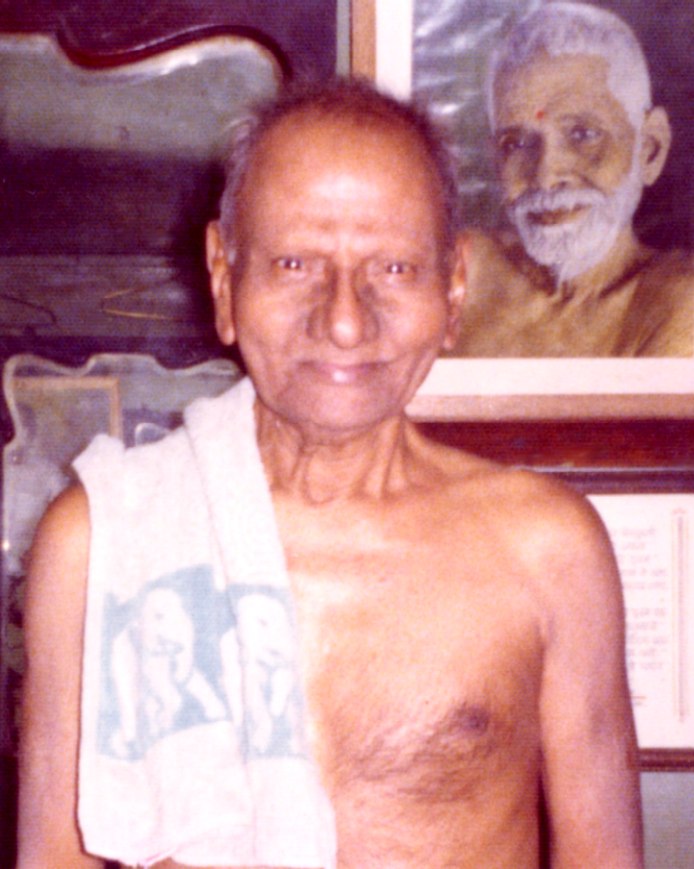
QUOTES OF NISARGADATTA MAHARAJ

Nisargadatta Maharaj--My Recollections

THE ULTIMATE MEDICINE

1. When that witness itself, which is ‘I am’, subsides, what remains? With the witness gone, all other things have disappeared too. By the same token, upon the arising of the ‘ I am’, the whole manifestation takes place; these two are not separate, they are one, ‘I am’ is the witness, the entire manifest world is because of this.

2. When ‘I am’ arises, everything appears; when ‘I am’ subsides everything subsides. Now this what I am trying to tell you, but you want something else. You want something about your future, something which is part of manifestation, but I am trying to hit at it.

3. This ‘I am’ is an announcement, it is not the real, it has come out of something else. What the real is, I am not trying to tell you, because words negate that. Whatever I am telling you, is not the truth, because it has come out of the ‘I am’.

4. While I am talking about it (‘I am’) I take you to the source of the spring. There, water is coming out in a trickle now. This trickle subsequently becomes a river, an estuary, and finally the sea, I take you  to the source again and again. Once you arrive at the source, you come to know that actually there is no water, the water is purely the taste, the news that ‘I am’.  

5. There is no explanation for how this seed, this consciousness or knowledge ‘I am’ has arisen. But once it is in existence, it cannot stand still – that is, consciousness is tantamount to ‘movement’. And all movement takes place through the ‘gunas’, which are inherent in the knowledge ‘I am’. This consciousness keeps on ‘humming’ – (Maharaj uses the Marathi word ‘gun-gun’) – and expresses itself through the three ‘gunas’.

6. This ‘gun-gun’ is within the knowledge ‘I am’, which includes the physical form. The ‘gun-gun’ entity and the knowledge ‘I am’ and the physical form – that whole bundle – has been created out of the five elements. So up to this point, the whole thing can be said to be entirely mechanistic and therefore pure ignorance.

7. How did I get this birth? That is the point on which I persist in finding the answer; I ‘must’ know this. When I was told ‘sattva’, then what is ‘sattva’? ‘Sattva’ is the essence of the five elements. In that essence, in that juice, lies the knowledge ‘I am’; but all that is still of the five elements. Then how did this come about? My guru told me the whole story. Thus I came to know it is ignorance, and I know from experience, that everybody is starting from there. Thus whatever has come about is sheer ignorance, and we are nothing more, that is what my guru told me.

8. My guru further pointed out to me the fact that the only thing you have and which you can utilize to unravel the mystery of life, is this knowledge ‘I am’. Without that there is absolutely nothing, so I got hold of it, as my guru advised me, and then I wanted to find out how the spiritual aspect of ‘me’ came about without my knowledge. On my pure Absoluteness, which has no place, and no shape or form, this knowledge ‘I am’ came, which also has no shape or form. Therefore, it appears; and it is only an illusion.

9. This beingness, the knowledge ‘I am’, which I call ‘upadro’, is the source of trouble. In this ‘upadro’, in this primary essence, lies the knowledge ‘I am’ – you know that you are. This quality of beingness (‘sattvaguna’), the knowledge ‘I am’ cannot tolerate itself. It cannot stand itself, alone, just knowing itself. Therefore that ‘rajoguna’ is there… it takes the beingness for a ride in various activities, so that it does not dwell on itself; it is very difficult to sustain that state. And ‘tamoguna’ is the basest quality, it claims authorship or doership for all those activities conducted through ‘rajoguna’. This is the play happening in these three gunas (qualities). Again understand, you are experiencing this ‘sattvaguna’, the knowledge ‘I am. This ‘I amness’ is experienced by you, the Absolute, but you are not the ‘I amness’.

10. ‘Sadhana’, the discipline, is only this: The knowledge which is dwelling in this body, the quintessence of these three ‘gunas’ – the knowledge ‘I am’, ‘I am that’ – this is the initial step. You must be one with it; you must abide in that only. You have to think ‘ I am not the body but I am that formless, nameless knowledge indwelling in this body’; that (is) ‘I am’. When you abide sufficiently long in this state, whatever doubts you may have, that knowledge ‘I am’ itself will sprout out with life and meaning for you, intended for you only, and everything will become clear. No external knowledge will be necessary.

11. Conviction! That is the only technique for the ‘sadhana’ if you are thinking of any initiation…only the words of the guru that you are not the body! That is the initiation. Stay put there, in that state. It is spontaneous, natural, that ‘shraddha’ (faith). What is that faith? ‘I am’ without words, whatever you are that is the faith. Now you have to elevate yourself to the state of ‘Brahman’; this is the condition you have to develop.

12. What exactly is born? What is born are three states: the waking state, the sleep state, and the knowledge ‘I am’, this consciousness. The body and the vital breath would not be able to function if this consciousness were not present. These three states work through the three attributes (‘gunas’). I very clearly see that which has been born. And I also know that I am not that which is born. And that is why I am totally fearless. So this knowledge ‘I am’, this consciousness, this feeling or sense of being, is the quintessence of the body. And if that body essence is gone, this feeling, the sense of being, will also have gone.

13. Once the body and the sense of being(‘I am’) goes what remains is the Original, which is unconditioned, without attributes, and without identity; that on which this temporary state of the consciousness and the three states and the three ‘gunas’ have come and gone. It is called ‘Parabrahman’, the Absolute.

14. In that ‘Parabrahman’, which unconditioned,, without attributes, without identity – the identity comes only when there is the knowledge ‘I am’ – so if that itself is not there, who is there to ask? This is to understood not by ‘someone’ (with a body-mind identity), but it must be experienced, and in such a manner that the experiencer and experience are one.

15. When the truth came out, it was found that in a certain atom the entire Universe is contained. And what is that atom? It is the beingness, the knowledge ‘I am’. That contains the whole Universe.

16. The atomic consciousness contains the whole Universe, but yet he (the jnani’) knows that he is not that consciousness. So in that case what pride can he have? He is the Absolute state, in which the ‘I am’ consciousness is absent. If you meet any ‘jnanis, you will find it easy to recognize them, for they will not have any pride in their Self-knowledge, since they have transcended that knowledge also. They say ‘I am not this knowledge or this consciousness’.

17. My statement, and that of my guru, is that childhood is a cheat, it is false. The knowledge ‘I am’ itself is a cheat. When the beingness appears, that love for existence is a result of the primary illusion, that ‘maya’. Once you come to know that you exist, you feel like enduring eternally, you always want to be, to exist, to survive. And so the struggle begins, all because of ‘maya’.

18. This knowledge ‘I am’ has dawned on you, since then whatever other knowledge you have acquired, whatever experiences you have had, whatever you have seen of the world has all been witnessed. But that one to whom the witnessing takes place is entirely separate from that which is witnessed.

19. You base yourself on the body that you are now, and don’t understand its root. That is why we think we are this body, and for that you must do meditation. What is meditation? Meditation is not this body-mind meditating as an individual, but it is this knowledge ‘I am’, this consciousness, meditating on itself. Then the consciousness will unfold its own meaning.

20. This itself is the greatest miracle, that I got the news ‘I am’, have you any doubts that you are? It is self-evident. Prior to knowing that you are, what knowledge did you have? ‘Dhyana’ means to have an objective. You want to consider something. You ‘are’ that something, just to be, you are. Just being the being ‘I am’. You meditate on something; that knowledge ‘I am’ is yourself. Abide only there. How can you ask any questions at this point? Because that is the beginning of knowledge.

21. By reading various books and listening to everything else, you cannot become a ‘mahatma’, but only through that knowledge ‘I am’. Don’t concentrate on the body; because of a body you call yourself male or female. Just hold on to that knowledge ‘I am’ only without body sense – beyond name and form or design. But you have to employ name, form and design for the sake of worldly activities.

22. You must have a firm conviction that ‘I am’ is only that ‘I am’ without body-mind form – the knowledge ‘I am’ purely. You say all these things, but has the knowledge come within the purview of the knowledge? You must have that full conviction, whatever you may have said, that is the truth and that is ‘I am’. There are no techniques, except the technique that ‘I am’ the firm conviction that ‘I am’ means ‘I am’ only, abidance in ‘I’. Don’t practice this thing, only develop your conviction.

23. This conviction can be strengthened by meditation, like ‘dhyana’. And ‘dhyana’ means the knowledge must remain in meditation with the knowledge. Now, what is meditation? Meditation is the knowledge ‘I am’ remaining in that knowledge. There is the waking state and the sleep state, and the knowledge that you are, I exist, I know that I exist. Other than that what capital does anyone have than merely knowledge ‘I am’? ‘Dhyana’ is when this knowledge, this consciousness that I am,

meditates on itself and not on something other than itself.

24. When you say you sit for meditation, the first thing to be done is understand that it is not this body identification that is sitting for meditation, but this knowledge ‘I am’, this consciousness, which is sitting in meditation and is meditating on itself. When this is finally understood, then it becomes easy. When this consciousness, this conscious presence, merges in itself, the state of ‘samadhi’ ensues. It is the conceptual feeling that I exist that disappears and merges into the beingness itself. So this conscious presence also gets merged into that knowledge, that beingness – that is ‘samadhi’.

25. There is that nine-month period in the womb. So what is the content of the womb? It is that knowledge ‘I am’ in dormant condition. This is being developed slowly, so within the birth principle everything is contained. That which is called birth, the birth principle is ‘turiya’; the experience that you exist itself is ‘turiya’. ‘Turiya’ means where the consciousness is. One who knows ‘turiya’ is ‘turiyatita’. That is my state. ‘Turiya’ is within the consciousness, which is the product of the five elements. And one who transcends that, who knows the ‘turiya’, is ‘turiyatita’. In order to stabilize in ‘turiya’, you must know the birth principle. ‘Turiya’ is always described as the witness state that see through waking, dreaming and sleeping. And ‘turiyatita’ is even beyond that.

26. This ‘I am’ concept was not there prior to what you call ‘birth’. So as this concept has appeared, it will also go away. How am I affected? In no way whatsoever, because it is not true. This applies to all concepts. Prior to birth and after birth, whatever knowledge I have, my own, without hearing it from any one, that is the only true knowledge I accept. And the proof lies in my guru’s words.

27. The body dies. This means what? It means only the thought ‘I am’, that concept, has disappeared. Nothing has happened to the knower of the whole happening. So long as the basic concept ‘I am’ is there, the conceptual element cannot disappear. It is the concept itself that has given various names to itself, but it is still the same concept. Before this concept of ‘I am’ came on you, were you happy or unhappy? Was there even any feeling of happiness or unhappiness? Any of the dualities? In the absence of the basic concept ‘I am’, there is no thought, no awareness, and no consciousness of one’s existence.

28. Originally, I am untainted – uncovered by anything, without stigma – since nobody existed prior to me. Nor do I entertain any concepts about somebody existing, before me. Everything is in the form of the manifested world, after the appearance of the knowledge ‘I am’ with the body. Together with the body and the indwelling ‘ I amness’ everything is. Prior to the appearance of this body and the knowledge ‘I am’, what was there?

29. The feeling ‘I am’ is the quintessence of everything, but I the Absolute am not that. That ‘I amness’ is the highest knowledge. And this is surrendered here by the abidance in the action.

30. So long as the concept ‘I am’ is still there, they (people who contact maharaj) have not gone beyond or prior to it; they have not gone beyond the total manifestation. So now when people come here, I talk with them, from what level am I talking? I am talking from the level that you are consciousness and not the body-mind. In my state whatever comes out is from the total manifestation, not from the point of view of the Absolute. Hang on to that consciousness, which is your only capital, and do ‘dhyana’ and let that unfold whatever knowledge has to be unfolded.

31. At present you wrongly identify yourself as the body. Body is given a certain name; that is ‘you’; you consider it to be like that. But I say that in this body, consciousness is present, or the knowledge ‘I am’ as I call it, is there. You should identify yourself as this knowledge. That is all.

32. For meditation you should sit with identification with the knowledge ‘I am’ only and have confirmed to yourself that you are not the body. You must dwell only in that knowledge ‘I am’ – not merely the

words ‘I am’. And the indwelling knowledge that you are, without words, that itself you are. In that identity you must stabilize yourself. And then whatever doubts you have will be cleared by that very knowledge, and everything will be opened up to you.

33. Forget all about physical disciplines in this connection. I am telling you that the indwelling principle ‘I am’, the knowledge that you are, you have to ‘be’ that. Just be that, with that knowledge ‘ I am’, hold on to the knowledge ‘I am’.

34. You know you are sitting here; you know you are, do you require any special effort to hold on to that ‘you are’? You know you are; abide only in that. The ‘I am’ principle without words, that itself is the God of all ‘Ishwaras’.

35. If you identify yourself as the body, such an identity must be let go of, sacrificed. Your real identity has no body and no thought. And that self, the spontaneous knowledge ‘ I am’ you are. Since the self is not the body, the self is neither male nor female. You must fulfill the vow that you are not the body but solely the indwelling principle ‘I am’.

36. With firm conviction, you abide in this knowledge ‘I am’ only; bereft of body-mind sense, only ‘I am’. If you dwell therein, if you be that only, in due course it will get mature. And it will reveal to you all the knowledge. And you need not go to anybody else.

37. The concept ‘I am’ is the primordial ‘maya’. And that ‘maya’, that primordial concept ‘I am’ requires support and therefore God and ‘Ishwara’ have been born. Along with that the whole manifestation, the entire Universe, has come upon it. Otherwise, there is absolutely nothing. And out of many ‘jnanis’, there will only be a rare one who knows the real nature of this primary concept.

38. First, the knowingness knows itself, knowing that ‘I am’. And in the illumination by that ‘I amness’, or that consciousness, everything else observed. I have had to repeat the same thing again and again, and I do not want to run kindergarten classes of spirituality.

39. All this is the play of concepts. The primary concept ‘I am’ appears spontaneously. It likes ‘I am’; it loves that ‘I am’ state. Devouring ever more concepts, it gets totally enmeshed in them. And what is the source of all concepts? This primary feeling ‘I am’. But never forget the fact that it itself is a concept, time-bound. And so it is all mental entertainment.

40. What equipment you are having is that ‘prana’. ‘Upasana’ means worship, worship of ‘prana’ itself. For doing that what equipment do you possess? It is ‘prana’ itself. Along with ‘prana’ there is that knowledge ‘I am’, or consciousness. These two things are available to you to do anything, nothing more than that.

41. In the absence of beingness, when you did not know about your existence? Nothing was of any value to you. This memory ‘I am’ is neither true nor false; it is without these two attributes. That memory of beingness only appears to exist.

42. For eternal peace you must dwell in yourself, know how this touch of ‘I am’ has appeared. All other knowledge is of no use in this connection.

43. Where there is the vital breath, the knowledge ‘I am’ is present. There being no vital breath, the knowledge of ‘I amness’ is absent. Take full advantage of the naturally available capital with you – that is, your life force and the knowledge ‘I am’; they always go hand in hand. Right now, exploit it to the utmost. All worldly activities are going on only because of the knowledge ‘I am’ together with that motive force which is the life force, the vital breath. And that is not something apart from you; you are that only. Investigate and study this exclusively, abide in that, worship that only.

44. What is this state before this knowledge ‘I am’ came upon me? When the knowledge ‘ I am’ came, the one who is satisfied with that will reach the state where he considers himself God and ‘Brahman’. But he does not go beyond it or prior to it. In the ultimate state lies the prior state; that is, the state before this knowledge ‘I am’ ever dawned on me – the highest state, the best state, the original state.

45. I call a ‘siddha’ one who has attained the ultimate, in that ultimate state, the devotee and God, the ‘maya’ (primary illusion) and the ‘Brahman’ have disappeared. And, there is no beneficiary or experiencer of all that, because he is without the concept ‘I am’. He does not know ‘I am’, he does not know that he exists in that state, that knowingness is completely obliterated.

46. This primary concept is the knowledge ‘I am’, it is the mother of all other concepts. In order to get that satisfaction, you must find the source of this primary concept ‘I am’. You should give attention to the knowledge ‘I am’ and meditate on that itself. Knowledge is to be got hold of knowledge only. This will produce the seed, which, through this process of meditation, slowly grows into a big tree, and that itself will give you all the knowledge. It will not be necessary for you to ask anyone what is what.

47. These two entities are available to you, the vital force and the knowledge ‘I am’, the consciousness. They appear without any effort; they are there. Now, in order to be one with ‘Ishwara’, to understand

the non-duality you must worship the vital force. Then that knowledge, which is in seed form, slowly grows. And the seeker becomes full of knowledge; in the process he transcends that, and the ultimate state is achieved.

48. ‘I am’ itself is the world; it contains the entire world, that should be your conviction. Just as in a dream, when you feel that you are awake, but actually you are not and your world at that time is the dream world. Similarly this knowingness (in the waking state) contains this so-called real world; that conviction must come. The truth is that there is no difference between (dream) consciousness and (waking) consciousness, although they appear to be greatly different; all consciousness is one.

49. The conviction that this world never existed can happen only to ‘Parabrahman’. If this is indeed your conviction then you are the ‘Parabrahman’. This thing aside, you should discover how this news ‘I

am’ – the knowledge of your existence – appeared and at what moment. Go to the source of it and find out.

50. The words of ‘prana’ signify mind. So how could there be mind without vital force? This vital force and the consciousness (that is, the knowledge ‘I am’ or the beingness and the mind) appear simultaneously and always exist together.

51. Before descending into this ‘avatar’, this knowledge quality was not present; knowingness was not there. The ‘I am’ was absent, not available. It is a non-knowing state, but afterwards, the state comprises all conceptual titles and names, and they are a person’s shackles. Any person, any embodied person with that knowledge ‘I am’ carries on his activities in the world with shackles of name only.

52. Once it is understood that ‘I am’ is purely ‘I am’, formless and not that shackled body form – then no liberation is called for. To be stabilized in that beingness, which has no name and form, that itself is

liberation.

53. Understanding what that ‘avatar’ is, Lord Krishna avatar, means in essence abiding in that only. Then one is not the body. And what is the body? It is a mere aid for the sustenance or endurance of that ‘I am’ principle.

54. The vital breath gets conditioned or manacled by the bondage of name. It accepts the name as ‘ I am’; this is the mistake. That which is deconditioned from name and form is ‘Paramatman’. That which conditioned by the body, mind, name and form is called ‘jiva’. The language of the vital breath is mind, and the mind is the motive force for all activities.

55. If you are able to establish yourself in the vital breath as you are, you become manifest. The vital breath, when it is conditioned by the body, you call it personality. But as a matter the vital breath is spread all over, it is manifest; it is universal. If you establish in the vital breath as ‘I am’, that in itself will get you there. Don’t be dishonest to your vital breath, worship it, and when you do so, it can lead you anywhere, to any heights – this is the quintessence of my talks. In such simplified fashion, nobody has expounded this profound teaching.

THE NECTAR OF IMMORTALITY


1. Here is an article before it came into existence, what was its name? From non-being into the being state, how was it observed? You just felt that touch. Before observing anything we feel the touch of ‘I am’. To realize that state prior to conception, that eternal state, whatever that state is, to abide in that is the highest. Now, for your sake, I attach a name to it, the ‘Parabrahman’ state – the Absolute.

2. A ‘jnani’ knows that he has realized when he recognizes his knowingness, which is the sense of ‘I am’. Right here and now you are in the realized state. But you try to judge it through desires and mind-concepts, hence your inability to apperceive it and abide in it. In the ‘jnani’ state, there is no need for anything, not even to know oneself. You are attached to the body-senses, therefore even though you may attain an age of hundred years, you still would crave for more years.

3. On the state of ‘non-beingness’, the beingness appeared together with manifestation, creating a feeling as if ‘I am ; who that is, is not important, only ‘I am’ is important. The initial humming of the beingness as ‘I am, I am’ is the duality. But who accepts the duality? The ‘non-beingness’ accepts duality with the beingness. The Absolute ‘non-being’ state, by assuming the being state, becomes dual in manifestation.

4. First you have what is called ‘atma-bhava’ – that is the ‘I am’ sense. Later, this sense identifies with the form of a body, when it is called ‘aham-akar’, the ‘I am’ form, this is ego. Ego is never a title or name, but just a sense of ‘I am’ prior to words. The waking state, the sleep state and the knowingness ‘I am’ constitute an ego. In the absence of these three states what do you think you are? What would be the evidence of your existence?

5. The knowledge ‘I am’ is nothing. That knowledge is like a guest; it comes and goes. You have come here; you are very clever. Now what did happen? All the knowledge, which you had collected elsewhere and brought here, is rendered useless and redundant. So long as beingness is there, all worldly activities will go on. But you now realize that ‘You’ are neither the activities in the beingness nor the beingness. You’ as the Absolute, are none of these.

6. With the transcendence of the knowledge ‘I am’, the Absolute prevails. The state is called ‘Parabrahman’, while the knowledge ‘I am’ is termed Brahman. This knowledge ‘I am’ or the beingness is illusion only. Therefore, when Brahman is transcended, only the ‘Parabrahman’ is, in which there is not even a trace of the knowledge ‘I am’.

7. First there was no message ‘I am’ and also there was no world. Instantly, the message ‘I am’ and this magnificent world materialized out of ‘nothingness’! How amazing! This message ‘I am’ is nothing other that the advertisement of the Eternal Truth.

8. How was I in the absence of the message ‘I am’ – that is, prior to beingness? I provided you with the name tags for that state. These titles are ‘Parabrahman’, ‘Paramatman’ etc.; they are only pointers to the state, but not the state itself. In the Ultimate they are redundant, extraneous and bogus.

9. The primary miracle is that I experience ‘I am’ and the world. Prior to this experiencing, I abided in myself, in my eternal Absolute state. Without my beingness – that is, without the message ‘I am’ – my eternal Absolute state only prevails.

10. The eternal Absolute state of mine prior to the beingness, when the message ‘I am’ was not, is supremely significant. Who would have witnessed the message ‘I am’, if my priormost state of the ‘non-beingness’ was not?

11. If one obtains and relishes the nectar of the Lord’s feet, the ‘charan-amrita’, the mind can be conquered. This is called ‘manojaya’ – victory over the mind. However, only a true devotee, a ‘bhakta’, a god, can obtain the ‘charan-amrita’. But what is its relationship with all beings? It dwells in the core of all beings as the knowledge ‘I am’, the love ‘to be’, the ‘charan-amrita’.

12. But how can such a state be attained? Only if one totally accepts the knowledge ‘I am’ as oneself with full conviction and faith and firmly believes in the dictum ‘I am that by which I know I am’. This knowledge ‘I am’ is the ‘charan-amrita’. Why is it called ‘amrita’ – the nectar? Because it is said, by drinking nectar one becomes immortal. Thus a true devotee, by abiding in the knowledge ‘I am’ transcends the experience of death and attains immortality.

13. Once you subside into the consciousness, the factual state of Reality shall be revealed to you with the knowledge that will emanate out of you intuitively, like spring water. This will enable you to discern not what is real and unreal, but, most importantly, to realize what ‘I am’. And who could be that one? Surely not an individual who is trapped in the mind-shell, but that one is the knowledge ‘I am’ – the consciousness.

14. Consciousness is the sense of knowingness ‘I am’ without words, and it appeared unknowingly and unsolicited. Only in the realm of knowingness ‘I am’ – the consciousness – can a world be, and so also an experience. Hold on to this knowingness ‘I am’ and the fount of knowledge will well up within you, revealing the mystery of the Universe; of your body and psyche; of the play of the five elements, the three ‘gunas’ and ‘prakriti-purusha’; and of everything else. In the process of this revelation, your individualistic personality confined to the body shall expand into the manifested universe, and it will be realized that you permeate and embrace the entire cosmos as your ‘body’ only. This is known as the ‘Pure Superknowledge’ – ‘Shuddhavijnana’.

15. Now coming to a very subtle situation, what is it in you that understands this knowledge ‘you are’ – or from your standpoint ‘I am’ without a name, title or word? Subside in that innermost center and witness the knowledge ‘I am’ and ‘just be’; this is the bliss of being – the ‘swarupananda’.

16. Paths and movements cannot transport you into Reality, because their function is to enmesh you within the dimensions of knowledge, while the Reality prevails prior to it. To apprehend this, you must stay put at the source of your creation, at the beginning of the knowledge ‘I am’. So long as you do not achieve this, you will be entangled in the chains forged by your mind and get enmeshed in those of others.

17. This true knowledge, the knowledge ‘I am’, is also rendered the status of ‘non-knowledge’ in the final Absolute state. When one is established in this final free state, the knowledge ‘I am’ becomes ‘non-knowledge’.

18. For all beings it is the same experience. Early morning, immediately after waking, just the feeling ‘I am’ is felt inside or the beingness happens, and therefore further witnessing of all else happens. The first witnessing is that of ‘I am’, this primary witnessing is the prerequisite for all further witnessing. But to whom is the witnessing occurring? One that ever is, even without waking, to that ever-present substratum the witnessing of the waking state happens.

19. At present, ‘I am’ is in the beingness state. But when I do not have the knowingness of the ‘I am’ illusion, then the ‘Poornabrahman’ or ‘Parabrahman’ state prevails. In the absence of the touch of ‘I amness’ I am the total complete, ‘Poornabrahman’ state, the permanent state. The borderline of beingness and non-beingness is intellect-boggling, because the intellect subsides at that precise location. This borderline is the ‘maha-yoga’. You must be at that borderline, that ‘maha-yoga’ state’. You descend into the ‘godown’ of that state which has the title ‘birth’.

20. The sense that ‘you are’ is a big thing. What is most significant is the fact that you remember your sense of being, subsequently all other things appear. Earlier this memory ‘I am’ was not and suddenly it appeared. Now I expound on the spiritual talk called ‘niroopana’. In Marathi the word ‘niroopana’ is derived from the word ‘niroopa’ (nirope), which means ‘message’. Therefore, to deliver any spiritual talk that is ‘niroopana’, the primary message ‘I am’ must first be present, then whatever ensues from this primary message will be the spiritual talk.

21. This little container of food essence is being sucked by that beingness, ‘I am’ day and night. The principle that sucks that container is not the body; it is apart from the body. This beingness principle dwells in that food body itself. Just as the child sucks on the mother’s breast, the beingness consumes the body.

22. Just as the salty taste is present in the entire ocean, the beingness or the sense of ‘I am’ in the human form has the inherent capacity to be all-pervading, but having conditioned – and thereby limited – itself to the body form, it interested only in protecting and preserving the body.

23. How does one recognize this ‘atman’? It is by understanding the knowledge ‘I am’ – the ‘atmajnana’. Just as space is all-pervading, so the knowledge ‘I am’ is all-pervading, limitless and infinite. How strange, such a supreme principle is treated as though it is a body! All the sufferings are due to this mistaken identity. If you give the highest honor due to it, you will not undergo either suffering or death.

24. To abide in the knowledge ‘I am’ is one’s true religion – the ‘svadharma’. But instead of following it, you opted to be irreligious by submitting to the dictates of your concepts, which led you to believe that you are a body. This misconception ensured only the fear of death.

25. The fragrance or sweetness of the food-essence body is the knowledge ‘I am’. It has no name and form; it is the ‘I love’ state, the ‘I-taste’. But from your body-mind state, you will go to pilgrimages and various gurus. So long as the consciousness is there, that humming goes on, and who does the humming? The principle which is humming and saying, ‘I am, I am’ is itself your guru.

26. ‘Jnana-yoga’ means to inquire how this ‘I amness’ and the world came about. To realize that ‘I amness’ and the world are the same is ‘jnana-yoga’. Here the knowledge ‘I am’ should subside in itself.

27. The primary occurrence is the reminder ‘I am’ and out of which springs the language and the talk. So, what is this ‘I amness’? Remember that it is in the primary reminder ‘I am’ that the whole cosmos and your body exist. Who and from where is this sense of being? This has to be thoroughly investigated. When this is done, while abiding necessarily in the knowledge ‘I am’ – the sense of  beingness – an amazing revelation will be made, namely that from your own seed-beingness the whole manifest universe is projected including your body. This supreme and powerful principle, though being itself without form and name, upon sensing ‘I am’ instantly embraces the body and mistakenly accepts this as its own. It clings to the body-identity so quickly that the fact of its own independent existence is easily missed.

28. You are quite knowledgeable; now understand this; if you think you are dying, it shows that you still identify with your body and that your knowledge ‘I am’ has not merged in itself, which also indicates that you have not attained ‘jnana-yoga’. Your spiritual knowledge therefore smacks of impurity. While you are actually the manifest knowledge ‘I am’, you cling to a body as yourself; this is the impurity.’

29. Suppose a question is asked of you, what were you a hundred years back? You would reply ‘I was not’. That means, I was not like ‘this’, that is not like this present ‘I am’. Who (and how) could (he) say ‘I was not like this’? The one who says this, was he not there? The one who was prior to a hundred years was not like this present ‘I am’, but he was and is now.

30. Do nothing, absolutely nothing! Just be, be the knowledge ‘I am’ only and abide there. To imbibe this meditate on beingness only. Catch hold of the knowledge ‘I am’ in meditation. In this process, the realization occurs that ‘I’ the Absolute am not the ‘guna’ ‘I am’; therefore in meditation nothing is to be retained in memory. Nevertheless something will appear on the memory screen, but be unconcerned, just be, do nothing. Refrain from grasping anything in meditation; the moment you do, otherness begins, and so does duality. Nothing is to be done. Then all your riddles will be solved and dissolved. ‘Moolmaya’ – that is, the primary illusion – will release her stranglehold on you and will get lost.

31. At first ‘no one’ is. Instantly, one is, and then two. The subject of the talk is: How did these two reduce to one, and finally to nothing? Out of nothingness spontaneously the sense of beingness is felt - this is one. Later, when the sense of beingness knows ‘I am’ duality begins. Then after the duality has arisen, the sense of being identifies with the form, and so on. Actually to refer to the sense of being as ‘one’, is not quite correct. Since in this state only the sense of being prevails, where is the need to say even ‘one’? With the appearance of otherness (duality), both no.1 and no.2 appear simultaneously. To say ‘something is’, ‘I’ must be there first. If ‘I’ am not, I cannot say ‘something is’. So the fundamental principle of spirituality is that ‘I must be there, before anything else can be. This ‘I’ is the beingness which if first.

32. When you sit in deep meditation, your sense of being is totally infused with the knowledge ‘I am’ only. In such a state it will be revealed to you intuitively as to how and why your sense of ‘I amness’ emerged. Consciousness, beingness, sense of being, ‘I amness’, all are the same in you, prior to emanation of any words.

33. This is a subtle point, so try to understand it clearly. When I say ‘I was not’ prior to conception, then what I actually mean is that I was not like this present ‘I am’. But that ‘I’ which could discern this must be there to judge the absence of the present ‘I am’.

34. Shall we call the knowledge ‘I am’ the guru? But even that knowledge you are not! Knowledge ‘I am’ means consciousness, God, ‘Ishwara’, guru etc. but you the Absolute are not that.

35. This is to be understood and realized, that ‘I am’ is even before the arising of any words and questions in me. People always want a name or concept to indicate the state of ‘I am’ prior to words. When this is done by giving it a name, like for example Brahman, they feel satisfied.

36. Beingness can act in the world only with the aid of the body. This body is the quintessence of the five elements, and the quintessence of the body-essence is the knowledge ‘I am’. The presiding principle of the whole functioning is the knowledge ‘I am’. This knowledge ‘I am’ has to be correctly understood.

37. A body maybe dark, fair, tall or short, but the indwelling principle – which is the knowledge ‘I am’ – has no color or dimension, just like the vital breath and mind. It is merely a ‘sense of presence’ a feeling of effulgence. And mind functions like its vehicle or medium for executing worldly activities.

38. You should understand this clearly. If one thinks one is the body, one becomes a slave of mind and suffers accordingly. Therefore, you should completely identify yourself with the highest principle in you, which is the knowledge ‘I am’. This will elevate you to the status of ‘brihaspati’ – the guru of gods.

39. When the meditator forgets himself totally in meditation, it is ‘vishranti’ which means complete relaxation ending total forgetfulness. This is the blissful state, where there is no need for words, concepts or even the sense of ‘I am’. The state does not know ‘it is’ and is beyond happiness and suffering and altogether beyond words; it is called the ‘Parabrahman’ – a non-experiential state.

40. Before the emanation of any words, ‘I’ already exist; later I say mentally ‘I am’. The word-free and thought-free state is the ‘atman’.

41. The knowingness ‘I am’ is gradually felt by the child and this is followed by the mind. This ‘I amness’ feeling before the formation of the mind is the ignorant-child-principle, termed the ‘balkrishna’ state. 

This ‘balkrishna’ principle has great potential. Here ‘bal’ means the food essence, child-body, and ‘krishna’ means ‘non-knowing’, that is, ignorance. But it has the potential to receive, respond and react. I am not in this state, the child principle, ‘balkrishna’, as I abide in the Absolute.

42. At present you identify yourself with your body and mind. Therefore, in the initial stages of your spiritual practice, you should reject the identity by imbibing the principle that ‘I am’ is the vital breath and the consciousness only and not the body and mind. In the later stages, the vital breath and the consciousness – that is the knowledge ‘I am’ – merge in one’s ultimate nature.

43. That ultimate state is known as ‘vishranti’, which means total rest, complete relaxation, utter quietude etc. The other meaning, by splitting the word, would be, ‘vishara (visra)-anti’ – forget yourself in the end. That means in the ultimate state, ‘you-areness’ is totally forgotten. Whether ‘I am’ or ‘I am not’ both are forgotten. This is the highest type of rest – ‘parama-vishranti’.

44. When I pleased my ‘I amness’ by understanding it, only then did I come to know this ‘I amness’ and in the process also discovered that ‘I’ the Absolute, am not that ‘I am’. Stay put at one place. Having collected all the knowledge, ponder over it in seclusion.

45. You abide in that knowledge ‘I am’. You should understand that your destination is your own self, the ‘I am’. It is the very source of everything; That ‘I am’ is to be realized. Because ‘you are’, the consciousness is. Before you say ‘I am’ you already are. ‘I am’ – the word or the ‘I am’ feeling that you get inside you – is not eternal. But you are eternal and ancient.

46. You have to stabilize in your present true nature, ‘I am’. All other secondary and redundant objects should be got rid of. Do not focus you attention on any of these things. The whole process is to be in your source. At present, what is your source? ‘I am’. Catch hold of that ‘I amness’ and be in it. You have to realize your own self. You must be at the borderline between ‘I am’ and ‘Not-‘I am